
Walker Resident Lookup Record Routes
A name result has value only when its source answers the question being asked. Walker Assessing and the county parcel layer can connect a name with a tax or parcel association. The voter route addresses registration under separate privacy rules. Court indexes identify cases and parties, while vital records address a specific event. A LARA record can establish a professional credential or entity connection, but not a home address. The first pass in a resident lookup should therefore select the narrowest record that can confirm the fact at issue.
| Record | What It Confirms | Where | Access |
|---|---|---|---|
| Parcel and assessment record | Parcel association, situs, owner and tax-mailing fields | Walker Assessing and BS&A | Public portal and office contact |
| Voter registration | Status, clerk and polling information for the public lookup | Michigan Voter Information Center | Self-service lookup; QVF request has protected fields |
| Court index | Case number, court, type, party role and limited status information | MiCOURT and local court custodians | Public index; official file from the custodian |
| Vital event | A dated birth, death, marriage or divorce event | MDHHS Vital Records | Eligibility and product rules apply |
| License or entity filing | Regulated credential or organizational relationship | LARA License Finder | Public search; record scope varies |
Keep parcel owner, taxpayer, and property-address fields separate. Kent’s parcel data can show a mailing line that differs from the parcel’s situs, so it is not sound to convert an owner field into a claim of continuous occupancy. The same caution applies to an old directory listing or a court participant name. Note: A second independent source is the practical way to resolve a Walker name match.
Walker Court Matches for a Resident
MiCOURT Case Search is the statewide starting point for a case number or participant-name query, but it says its information is not the official court record. Its documented query qualifiers include first name, last name, full name, and case number. A result may provide a court, case type, participant role, and filing or status concept. The research did not verify a complete Walker result screen, so a missing docket entry or disposition should never be filled in from another source.
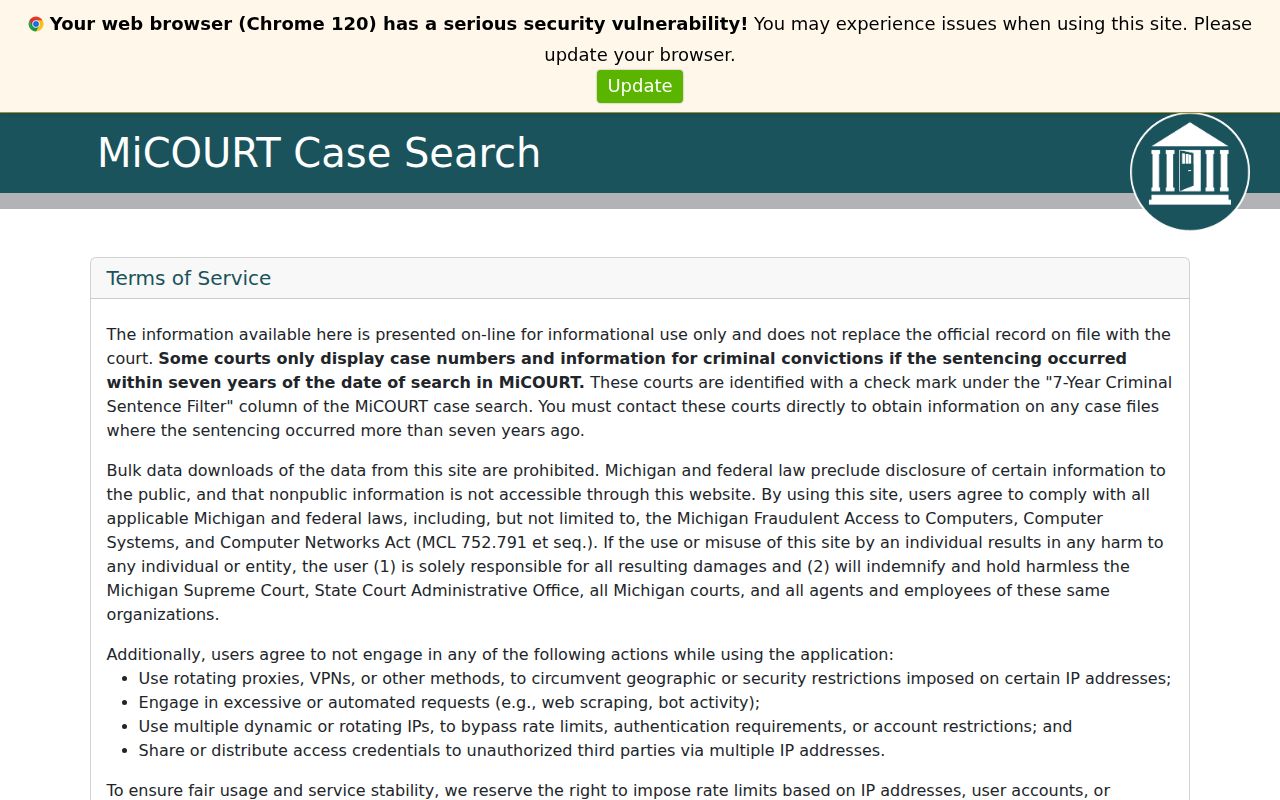
The MiCOURT entry point is useful for preserving the exact spelling and case number before contacting the court that controls the file. Some nonpublic case types do not appear, and the public display may apply a seven-year criminal-conviction filter. Those limits make a name hit a lead, not proof that a particular Walker resident is the party.
Walker’s 59th District Court serves Walker and Grandville and handles traffic and parking matters, civil filings up to $25,000, small claims, criminal cases, and marriage ceremonies. It is one channel among several: the 17th Circuit and the separate Probate Name Search handle different county matters. The Kent Court Clerk says criminal lookups use a full name plus date of birth, and Probate publishes its own copy fees. Use the court and case number to request inspection, a copy, or certification rather than relying on the statewide index alone.
The 59th District Court’s official page identifies its Walker location and public contact route for the local file.
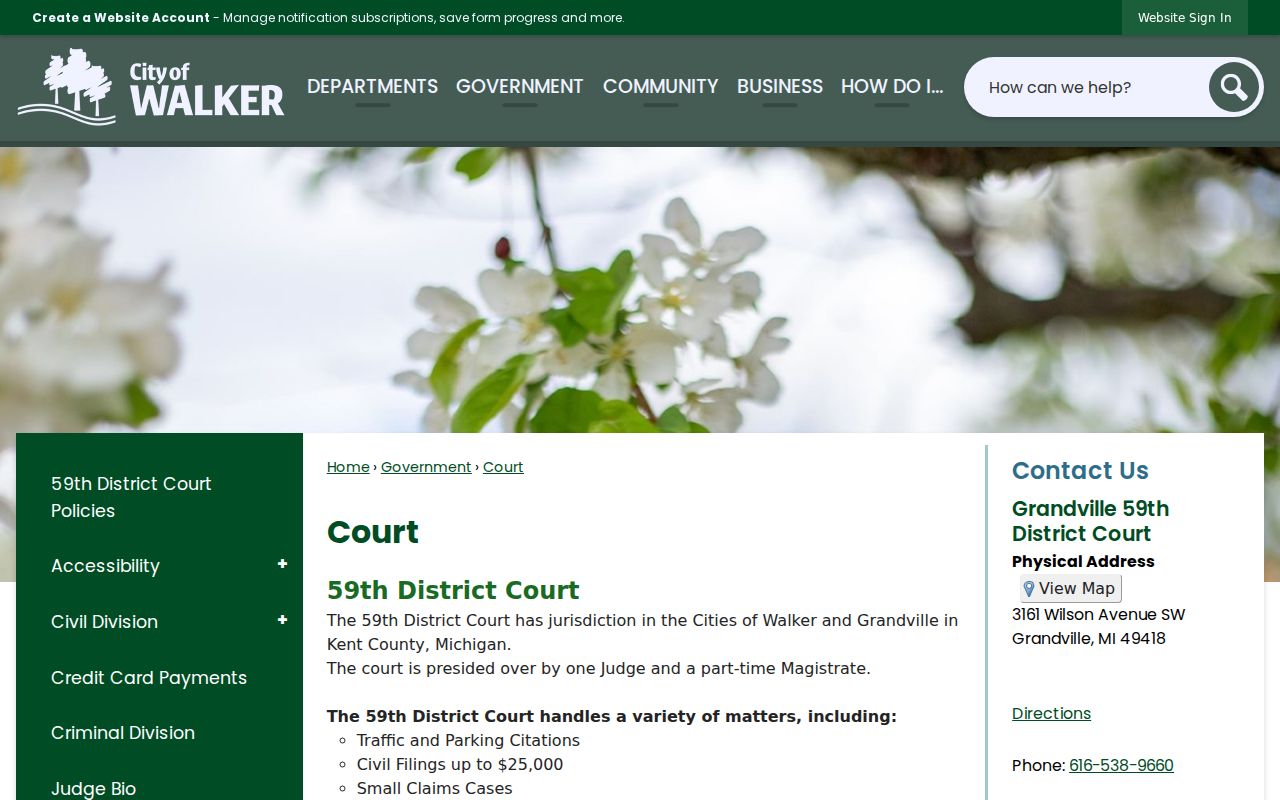
When a local record is needed, the court is the custodian that can explain what may be inspected or copied. The research did not establish a public-terminal arrangement or archived-case fee schedule, so confirm those details with the court before treating an online result as complete.
Walker Voter Checks for a Resident
The Michigan Voter Information Center uses a name workflow with first name, last name, birth month, birth year, and ZIP code. Its public functions can include registration status, clerk contact, polling place, and ballot or absentee tracking where applicable. It is not a public list of everyone on a Walker street. Michigan’s 2025 precinct change also means an older result can carry a different precinct without an address change.
MVIC’s official lookup is the source shown below for a self-service name check.
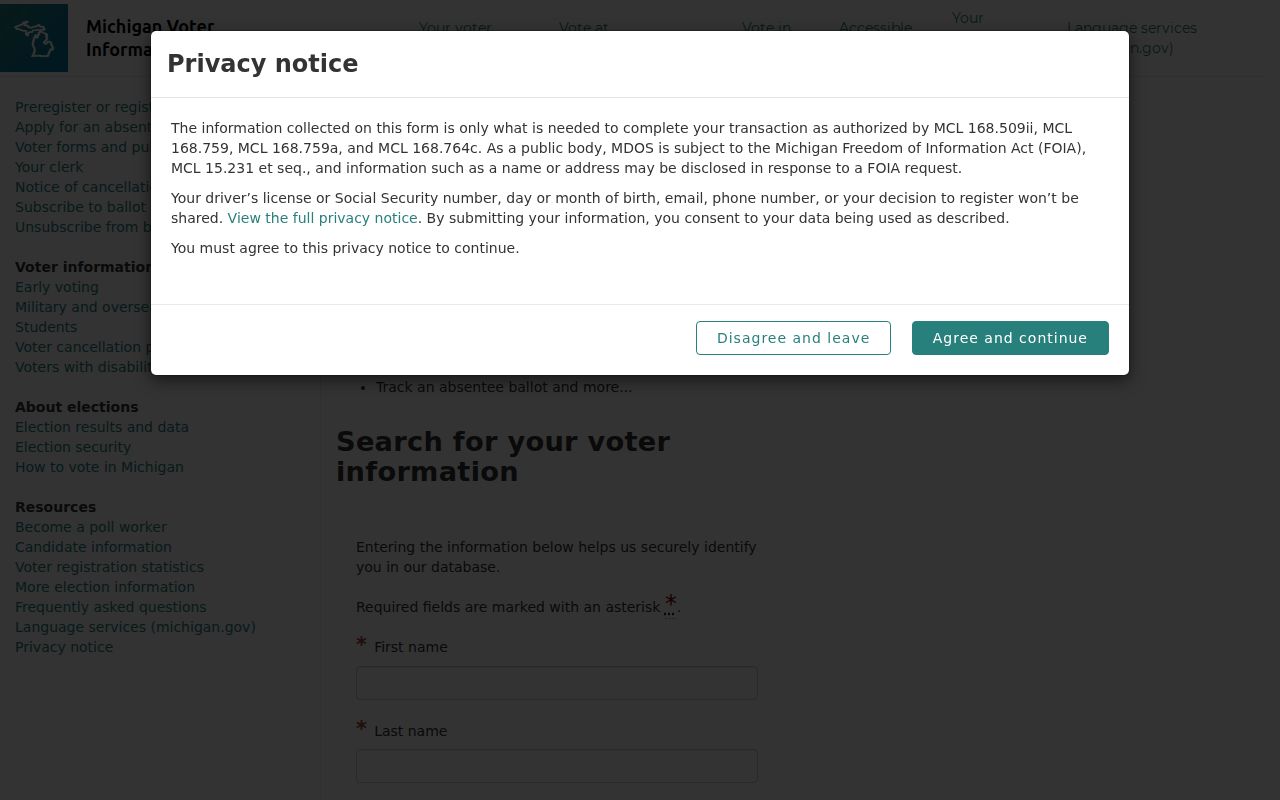
A Walker voter result should be recorded with its status date and precinct context. It cannot supply a private birth day, driver-license or state-ID number, telephone number, email, digitized signature, or last four Social Security digits. An apparent address mismatch can also reflect a valid confidentiality protection or routine list maintenance.
| QVF request element | Walker research use |
|---|---|
| Geographic scope | The form permits one scope, including city or township, ward or precinct, rather than a request for an unrestricted street roster. |
| Public fields | Complete name, residential address, mailing address where available, birth year, registration date, status, voter ID, and requested voter history. |
| Delivery | Pick up, FTP, or mail are listed. The research did not identify email delivery for the file. |
For a QVF request, use the Secretary of State form and its current conditions. The form lists MDOS-FOIA email and a Bureau of Elections mail route for the request itself, while delivery of the file follows the available choices on the form.
Verify a Walker Resident Record
A disciplined resident lookup tests identity across records that were created for different purposes. Preserve an original spelling, then add a middle initial, suffix, former name, or date range only as a search variant. If an address is known, begin with Walker Assessing or Kent GIS. Record the parcel number, the situs address, owner fields, tax-mailing fields, property class, and update date as distinct data points. Then use the Kent deed index to identify recorded instruments, not to replace the instrument itself.
- Anchor the name to a dated parcel, directory, voter, or event record. Preserve the source URL and how the name was spelled.
- Compare the parcel number and address fields with a Kent deed-index search for grantor, grantee, and recording date. Inspect the recorded document when the transfer matters.
- Search the appropriate court by full name and case number, using date of birth only where the custodian requires it for a narrower lookup.
- Use MDHHS or probate for a specific event or estate question, then resolve a conflict with a second independent source.
The minimum result ledger includes the source name and URL, search date, query spelling, record type, displayed person name, location field as displayed, date or record identifier, jurisdiction, and a confidence note. A parcel result adds the PPN, owner and mailing fields. A court result adds the court, case number, type, party role, and any visible filing or status field. Mark a field as unknown or redacted rather than importing it from a different record.
- Docket
- A court’s running list of filings and events in a case. A public index may not display every docket entry.
- Index and image
- An index is a finding tool or results row. The image or official file is the underlying document that needs its own review.
- Certified copy
- A copy issued or authenticated by the records custodian for uses that require official certification.
- Situs address
- The physical property address in the parcel record, which may differ from an owner’s or taxpayer’s mailing address.
Walker Court Systems Compared
One statewide search is not a complete answer for a Walker person. The local 59th District Court, MiCOURT, Kent’s 17th Circuit Court, and Kent Probate each respond to a different question. MiCOURT is an informational index. The 59th Court is the local trial-court route. The 17th Circuit is the county route for circuit records and certified requests. Probate is a separate name-search route when an estate, guardianship, or related matter is relevant.
| Route | Best use | Important limit |
|---|---|---|
| MiCOURT | Find a case number or participant-name lead | It is not the official record, and some cases are unavailable. |
| 59th District Court | Ask about a Walker or Grandville district-court file | Confirm inspection, copy, and archive procedures directly with the court. |
| 17th Circuit and Probate | Use the county court or probate route for its own matter type | Do not substitute older online-coverage statements for current access conditions. |
This division is a useful local comparison because a court participant need not be a Walker resident, and two people with the same name can appear in different forums. For an heir question, probate filings, a dated vital event, and the court’s definition of an interested person provide a stronger trail than a broad name search.
Walker Vital Event Confirmation
Michigan MDHHS Vital Records is the state route for certified births, deaths, marriages, and divorces. Michigan event records begin in 1867, while divorce records begin in 1897. A birth record under 100 years old has tighter eligibility under MCL 333.2882. Death, marriage, and divorce request rules are broader, but a verification product remains limited to the subject name, event date and place, and filing date. An obituary or directory entry is not a substitute for a certified record.
MDHHS documents several channels: mail, its authorized online provider, phone, drop box, and appointment or will-call options. The current page lists a standard search/copy fee, nonrefundable search outcomes, and different processing ranges for ordinary, expedited, genealogy, and apostille work. Select the product before ordering, because a verification, a genealogy product, and a certified copy have different fields and eligibility rules. The Kent County Clerk or local clerk can provide local guidance when a Walker event raises a county question, but MDHHS controls the statewide certified-copy route.
Note: Record the requested product and eligibility basis before treating a vital-record response as confirmation of identity.
Walker Resident Lookup Privacy
Michigan’s Address Confidentiality Program, created by Act 301 of 2020, gives eligible participants a designated substitute address and mail forwarding. The program serves eligible survivors and people at risk from domestic violence, sexual assault, stalking, or human trafficking. A substitute address can explain why a public record does not show a physical residence. Treat that condition as a protection, not as evidence that a person is absent from Walker.
Lawful use. Use a Walker resident lookup for personal, lawful research and records navigation. Do not publish protected fields, sealed material, victim information, or an actual protected address, and never use a result to stalk, harass, or intimidate anyone.
Michigan FOIA has a public-record presumption, but a custodian may redact personal identifiers, victim information, active investigative details, confidential sources, attorney-client material, sealed court information, and other protected content. A narrow request should identify the record, date range, and department rather than demand a person’s entire file. The Michigan ACP is not a public search source, and its application data should not be reproduced.
Correcting a Walker Record Match
When a result is wrong, preserve the portal URL or record identifier and contact the custodian that controls it. Walker Assessing or Kent Equalization can explain a tax record; the Register of Deeds controls the recorded instrument; a court clerk controls a docket; the local clerk or Secretary of State controls voter corrections; and LARA controls its license or entity filing. A correction request should identify the precise field, the supporting document, and the requested change. Keep the original and corrected dates in the research notes.
A dead end deserves the same precision. “Not located” differs from “not public.” An ACP address, sealed case, restricted birth record, non-indexed local record, a missing directory year, or a spelling variation can all explain an empty result. For a dated historical association, the regional directory and newspaper collections described on the Walker city directory page may offer a second source. Do not turn a silent search into an assertion about a person.