
Finding Walker Resident Records
Walker has no single public roll of every household. A useful Walker residents directory search begins with the kind of fact already known. An address can lead to a parcel number and owner field through the city assessor or county map. A recorded transfer can be checked through the Kent County Register of Deeds. A name with a likely court matter belongs in the appropriate court index, while an older household is often better traced in a Grand Rapids Public Library directory volume. Each source answers a narrower question than a general people list would suggest.
Keep ownership, mailing address, and occupancy separate. A tax parcel can identify a current owner or taxpayer, but it does not prove every person who lives there. A directory may place someone at an address when a book was published, not for every month around it. Court and voter systems have their own coverage and privacy rules. Combining dated records is more reliable than relying on one returned name.
- Start with the Walker assessor or Kent map when an address, owner name, or parcel number is known.
- Record the property address, parcel number, result date, and whether a field is an owner or mailing field.
- Use the deed index to locate a recorded transfer, then request or inspect the document if the legal chain matters.
- For a past household, compare Grand Rapids and Kent County directory volumes, reverse indexes, maps, and newspapers.
- Ask the named custodian for a specific record and date range when a public portal does not expose the needed item.
Walker Offices Behind Resident Records
Several custodians create the practical Walker residents directory trail. Walker Assessing maintains current ownership, value, and property-characteristic information. The Kent County Register of Deeds records deeds, mortgages, liens, and related instruments. The City Clerk handles local elections and routes city records requests, while statewide voter information and vital records have separate Michigan custodians. Walker is in Kent County, but Grand Rapids is the county seat, so county records are not all kept at City Hall.
Kent County Register of Deeds
300 Monroe Ave NW
Grand Rapids, MI 49503
616-632-7610
Deeds research and copies
Walker Assessing
4243 Remembrance Rd NW
Walker, MI 49534
616-791-6862
Walker BS&A Online
Walker Clerk and Michigan Elections
4243 Remembrance Rd NW
Walker, MI 49534
616-791-6865
Michigan Voter Information Center
Walker Parcel Records by Address
A Walker property search is usually the strongest current starting point when the search begins with a street address. The city’s BS&A landing offers detailed record, tax, sale, and building-department search routes. Its documented generic controls include record category, address, owner name, parcel number, and an advanced-address option. The exact Walker result screen was not captured, so a returned field should be read as the portal labels it. Kent’s public parcel layer supplies a second route and distinguishes a property or situs address from owner and taxpayer mailing fields.
Visit the Walker BS&A property portal before narrowing a name match. The captured landing page shows the local gateway used for property and tax research.
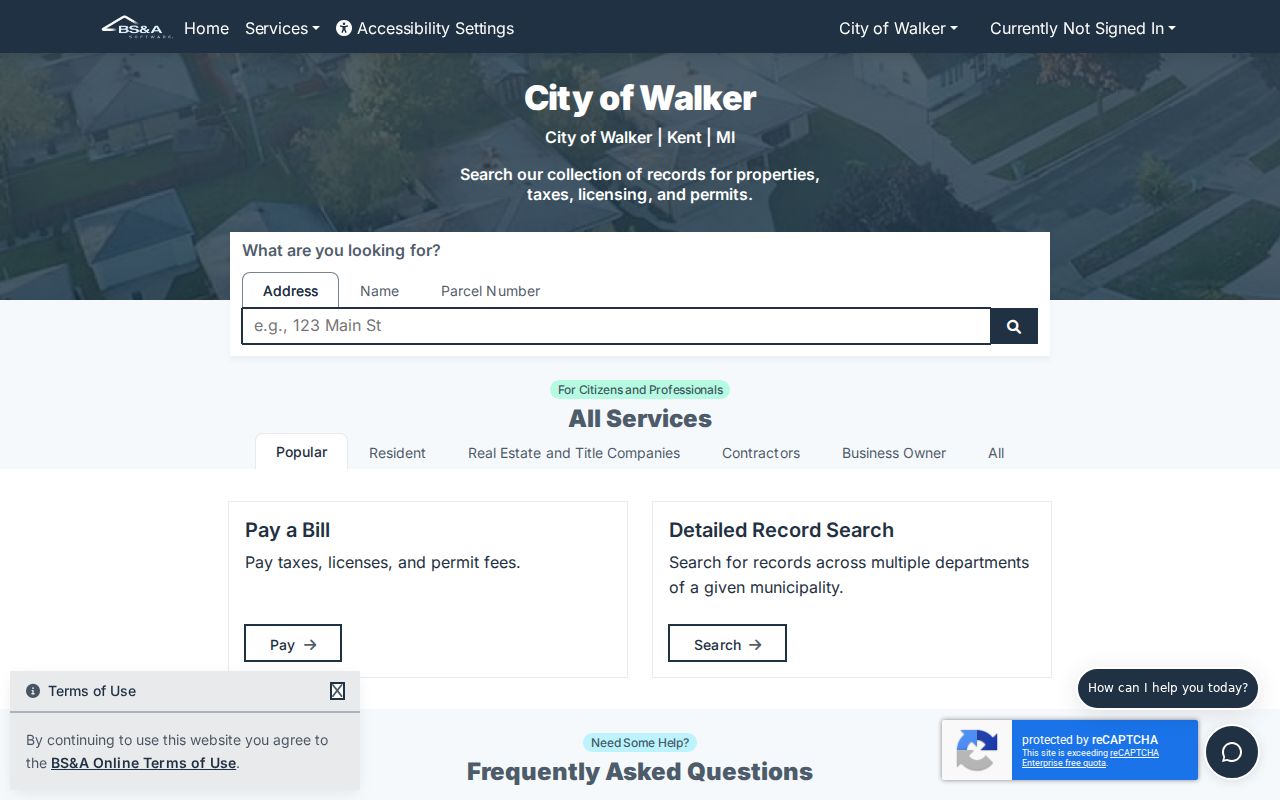
A parcel number, also called a PPN in Kent records, is the most stable way to carry a result between the assessor, map, and deed index. It is safer than assuming every address label refers to the same parcel over time.
| Field group | What it identifies | Careful reading |
|---|---|---|
| Property or situs address | The parcel’s physical location | Not necessarily an owner’s mailing line |
| Owner fields | Recorded tax-roll ownership data | Does not establish every occupant |
| Taxpayer fields | Tax correspondence contact | May differ from both owner and situs |
| PPN and class | Parcel identity and land classification | Use them to confirm the same property |
Walker Deed Index Research
The Kent County deed index can connect a Walker parcel to recorded transfers, but it is not the legal document itself. The county asks a researcher who does not know the owner to start with Equalization or the local assessor, then look for the owner in the Register of Deeds system. The Deeds Self-Service notice describes its search as a guide, much like a library catalog, and advises spelling variants. The public material did not establish an online start year, image price, or a complete live field list.
The Kent Register of Deeds office provides research and copy-request guidance for the recorded instrument.
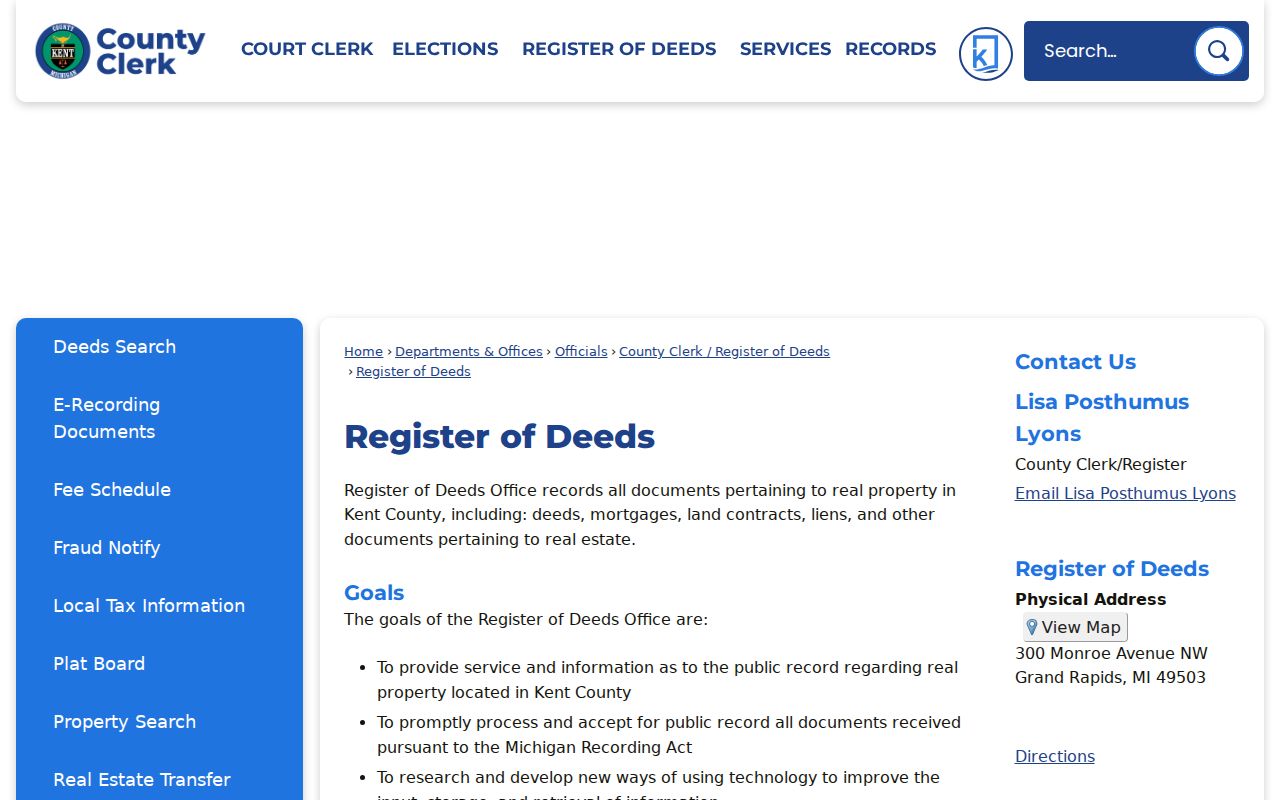
Use a document number, recording date, grantor, grantee, and legal description to test whether a hit belongs to the parcel. A grantor is the party transferring an interest; a grantee receives it. Request the document when a transfer date or legal boundary is important.
- Parcel
- A mapped unit of land identified by a PPN or parcel number.
- Index
- A finding tool that points to a record, not necessarily the complete record.
- Grantor and grantee
- The transferor and recipient named in a recorded instrument.
- Criss-cross directory
- A reverse directory that can connect an address back to a printed name.
Note: The county’s online deed cutoff was not verified, so an empty web search should be followed by an office or written-copy inquiry when the date range matters.
Current Walker Resident Sources
Current Walker residents directory evidence is fragmented by purpose. Assessment and parcel records can associate an owner or taxpayer with land. The Michigan Voter Information Center is a self-service registration tool, while the more detailed Qualified Voter File is a controlled public-record request with protected fields removed. Recorded documents identify parties to transactions. Court systems identify parties to eligible cases. None of these sources is a complete household roster, and a name should be checked against date, address, or case details before it is reused.
| Walker source | What it may confirm | Custodian | Access route |
|---|---|---|---|
| Assessing and parcel layer | Owner, taxpayer, situs, parcel class | Walker and Kent County | Portal, GIS, office review |
| MVIC and QVF | Registration information within public-field rules | Michigan elections officials | Personal lookup or controlled request |
| Deeds Self-Service | Parties and recorded-transfer leads | Kent Register of Deeds | Index, document request |
| City staff directory | Public departments and roles | City of Walker | Online routing tool |
| Library directory collections | Dated name and address entries | GRPL and related collections | Catalog, onsite, microfilm |
For one person rather than one parcel, compare independent results in the Walker resident lookup workflow. A court name match, for example, is only a lead until it agrees with the correct court, date, party role, and another reliable record.
Walker Voter Record Boundaries
The Michigan Voter Information Center is designed for a person to check registration and polling information. Its documented name workflow uses first name, last name, birth month, birth year, and ZIP code. That is different from treating the voter file as a street-by-street list. Michigan makes registration records public through its records process, but the Qualified Voter File request form protects driver-license and state-ID numbers, month and day of birth, phone, email, signature, last four Social Security digits, and other listed material.
The controlled request route allows defined geographic scopes and voter-history choices. It should be targeted to a legitimate record question, not a request for a person’s whole life. A substitute address through Michigan’s Address Confidentiality Program can also explain an address that does not appear in ordinary public-facing results.
Note: Walker changed precincts in 2025, so a historic precinct label and a current voting label may describe different electoral boundaries.
Walker Court Name Checks
Courts divide a name search by case type and custody. Walker is served locally by the 59th District Court, which also serves Grandville. Its work includes traffic, parking, civil matters within its jurisdiction, small claims, criminal cases, and marriage ceremonies. Michigan’s MiCOURT Case Search is the statewide public starting point, but it says plainly that it is informational rather than the official court record. Public availability is court-specific and nonpublic case types remain unavailable.
Use a MiCOURT result’s court, case number, party role, case type, and filing or status information to decide whether it warrants a custodian request. The 17th Circuit Court and Probate have separate Kent County routes, so one statewide search does not answer every court question.
Michigan Vital Record Confirmation
For a Walker birth, death, marriage, or divorce event, the Michigan MDHHS vital-record office is the principal certified-copy route. Michigan events begin in 1867, with divorce records beginning in 1897. Recent birth records are restricted under MCL 333.2882, while a birth record at least 100 years old is open under the state rule. Death, marriage, and divorce requests have broader access under their applicable MDHHS rules, although a verification product has fewer fields than a certified copy.
MDHHS offers mail, authorized online, phone, drop-box, and appointment or will-call channels. The standard search or copy fee listed in the research was $34, plus a $14 online processing charge when applicable, and a no-record outcome does not refund the search fee.
The MDHHS order page explains the state’s request path and eligibility materials.
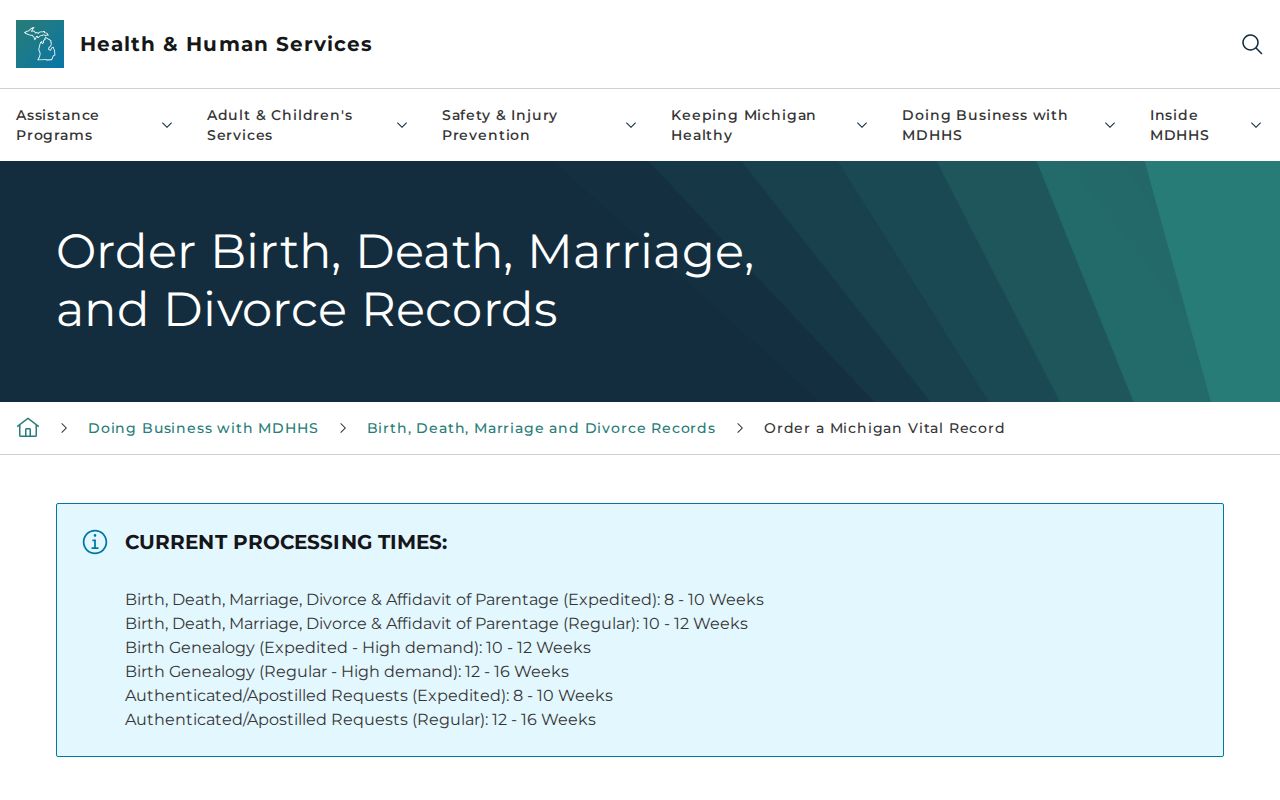
A verification can confirm limited facts such as name, event date and place, and filing date. It should not be described as the full certificate.
Walker Custody Record Scope
Custody and registry systems answer highly limited questions. Kent County’s jail viewer concerns current custody; Michigan Department of Corrections OTIS concerns the state system; the Michigan State Police registry has the separate scope set by its law; and ICHAT is a defined Michigan criminal-history product. A non-match is not proof that a person has no history, and a match does not by itself settle identity. Use only the official scope statement and the custodian’s correction process.
The Michigan State Police registry page is an official source for its own search instructions and limits.
Keep these systems separate from a general residents directory inquiry. They are not a substitute for court records, and public case results themselves can omit protected or nonpublic matters.
Walker Business Record Context
A business or professional filing can help distinguish a commercial connection from a residential claim. Michigan’s LARA corporations service directs users to MiBusiness Registry, launched June 23, 2025. Its documented search modes include entity name, individual name, identification number, and filing number. An entity record can identify a registered agent, filing history, or business status, but it should not be used to infer a private home.
The LARA corporations gateway captured in the project manifest is the starting point for Michigan entity and filing services.
For local licenses, Walker routes inquiries through the Clerk, and no public searchable city license roster was located. A direct city request or FOIA is the documented fallback for a specific local administrative record.
Walker Records When Portals Stop
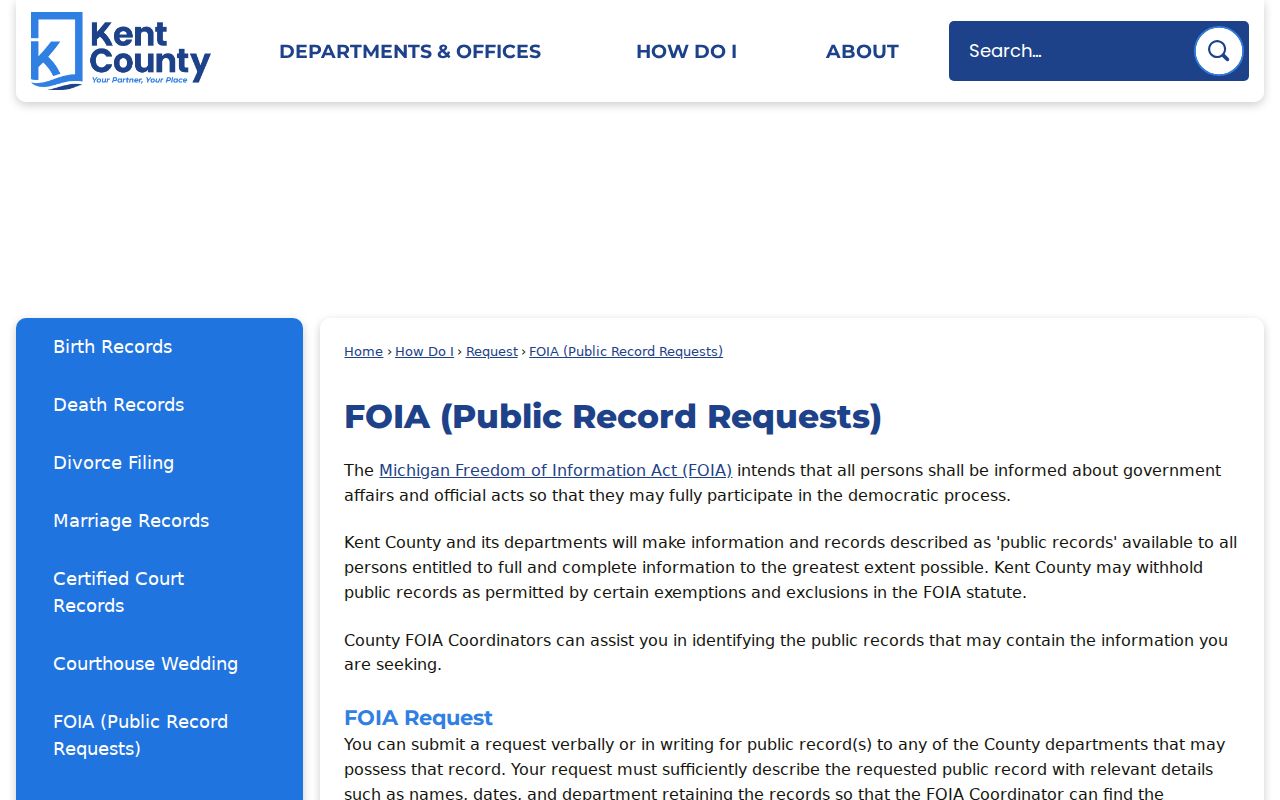
When an online index does not show a document, direct the request to the custodian that created it. Walker’s City Clerk routes city public-record requests, including separate destinations for departments. Kent County accepts online, mail, fax, and hand-delivered requests. Michigan Freedom of Information Act, 1976 PA 442, MCL 15.231 et seq., generally calls for a response within five business days, with a possible ten-business-day extension. Fees can include labor, copying, postage, and media under the applicable policy.
Use the Kent County FOIA page for the county’s current request methods, fee information, and appeal instructions.
A good request identifies a record type, address or name if relevant, a date span, and the department. Asking for a whole personal file is less precise and may draw valid privacy redactions.
Walker Postal Geography Checks
Walker’s official 2009 postal map shows four ZIP areas: 49321, 49504, 49534, and 49544. The postal city line can say Grand Rapids even when the parcel is in Walker. ZIP Code boundaries are not municipal limits, parcel lines, precincts, or planning neighborhoods. Confirm municipal location with Walker or Kent GIS, then use USPS for the current delivery ZIP. The city-office mailing ZIP, 49534, should not be used to classify every address in that ZIP.
Planning materials use Alpine/Bristol, South Walker, Standale, and Northwest clusters, which are another boundary system rather than a roster. Compare the map’s vintage and the record’s date before treating a mismatch as an error.
Historical Walker Directory Trails
Walker’s historical household trail often runs through Grand Rapids and Kent County collections. Grand Rapids Public Library holds city directories from 1856 to the present in its services overview, with catalog coverage described as 1859 to 1998, early microfilm from 1856 to 1956, the Grand Rapids Suburban Directory from 1957 to 1997 except 1989, and later Kent County East and West editions. Bresser’s Cross-index Directory covers 1962 to 2015. Each volume must be checked for its actual geography before assuming it includes a Walker address.
A printed entry can connect a name and address in a particular publication year, sometimes with phone or occupation details. The full collection, including how to use alphabetical and reverse sections, is on the Walker city directories page. GRPL’s History Center is on Level 4 of the Main Library, where some material is onsite only and research or copy services can carry a fee.
Note: Missing catalog years, including 1947, 1950, 1952, 1957, 1989, and 1991, are collection gaps and do not establish that a household disappeared.
Walker’s Fire Gap in Records
Original Walker Township records were destroyed in a fire in the mid-1800s. That local loss changes the order for early family research. Instead of expecting a municipal register to settle the question, compare county deeds and plats, church registers, newspaper notices, census schedules, neighboring-township material, and later histories. Mark the result as a reconstructed trail when the original record is gone. Walker Township began in 1837 and the city incorporated in 1962, so the governing body named in a record also matters.
The same caution applies to every modern result. Michigan’s Address Confidentiality Program, voter-file protections, restricted births, sealed court material, and redactions can lawfully limit what a search returns.