
Walker City Directory Collections
Walker is separate from Grand Rapids, but the historical directory trail is regional. The Grand Rapids Public Library History Center is the main starting point for books, microfilm, cataloged directories, maps, and local-history help. Its holdings can connect a Walker name or address to the appropriate Grand Rapids, suburban, or county-wide volume. A result from a Grand Rapids title does not by itself place a household inside Grand Rapids. Check the printed municipality, section, and year before drawing that conclusion.
| Collection | Documented run | Keeper | Access route |
|---|---|---|---|
| Grand Rapids city directories | 1856-present overview; cataloged set 1859-1998 | GRPL | Physical books, microfilm, and catalog handling |
| Grand Rapids directory microfilm | 1856-1956 | GRPL | Onsite microfilm |
| Grand Rapids Suburban Directory | 1957-1997, except 1989 | GRPL | Physical local-history source; check Walker inclusion in the volume |
| Bresser's Cross-index Directory | 1962-2015 | GRPL | Library reverse-address research |
| Kent County-East and Kent County-West Polk | 1998-present | GRPL | Catalog and library holdings |
Begin with the year and the geography, not a modern city label. Earlier volumes can offer an alphabetical name trail; a suburban or county edition may be the better Walker lead later on. The collection overview also lists selected scans in HathiTrust and Google Books, but rights and year availability vary. Physical GRPL copies remain the fallback when a scan is absent or incomplete.
Walker City Directory at GRPL
The History Center is on Level 4 of GRPL's Main Library, 111 Library St NE, Grand Rapids, MI 49503. Its staff invite in-person research help, while some research and copy requests have fees. Archive work uses collection, box, and folder identifiers. At a reading-room table, the stated handling limit is one box or five folders. Some material is onsite only, so a catalog hit is a reason to contact the library or visit, not an assurance that every item can be downloaded.
The History Center collection page shows the local-history setting used for Walker city directory research.
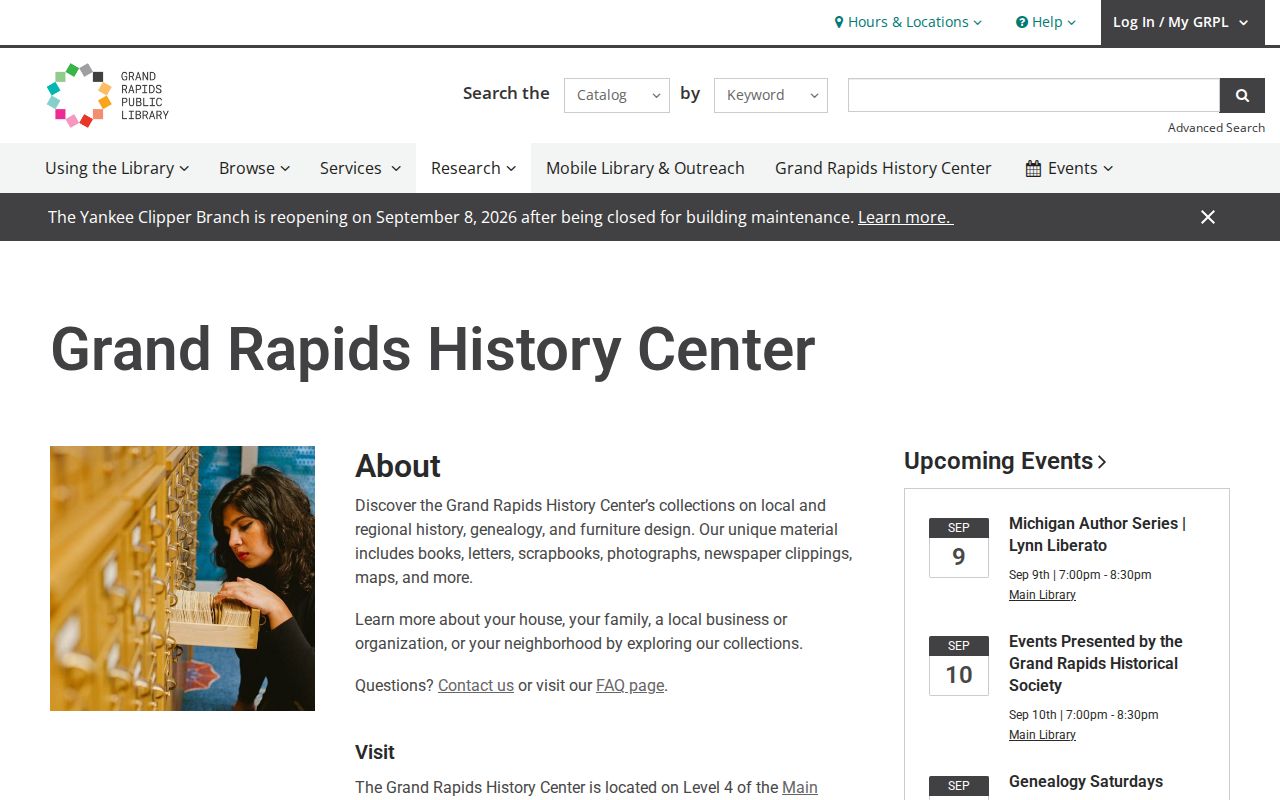
Use the desk and collection identifiers to locate a volume or archive folder, then record the title and date before copying an entry. The Main Library schedule lists Monday through Thursday hours of 9 to 9, Friday and Saturday hours of 9 to 6, and Sunday closure; the History Center phone is 616-988-5400.
GRPL Collection 301 contains more than 50 boxes and 29.1 linear feet of Michigan, Grand Rapids, and Kent County business, city, and telephone directories. Its oldest currently documented item is the 1859/1860 Williams directory. Some Polk volumes are in the public service area, while poor-condition items may be limited to microfilm or staff-approved copying. Those limits are part of the access record and should be noted with the citation.
Walker City Directory Gaps
The cataloged Grand Rapids run is not an unbroken annual record. GRPL identifies unpublished years of 1947, 1950, 1952, 1957, 1989, and 1991. A missing book should not be read as proof that nobody lived at an address. Compare the closest printed years, use the suburban or county volume when its geography fits, and then test the address against a deed, plat, newspaper, or census source.
- 1859/1860: the Williams Grand Rapids directory is the oldest documented item in Collection 301.
- 1856-1956: GRPL identifies a year-by-year city-directory microfilm run.
- 1957-1997: the Grand Rapids Suburban Directory covers surrounding Kent County municipalities, except 1989.
- 1962-2015: Bresser's Cross-index supplies a reverse name-and-address route.
- 1998-present: Kent County-East and Kent County-West Polk volumes continue county-wide coverage by geography.
The date labels describe collection coverage, not guaranteed Walker content in every volume. A librarian can help determine whether a particular suburban edition includes the needed municipality. Note: a directory gap is an instruction to compare adjacent sources, not a license to fill in a household by inference.
Reading Walker City Directories
A city directory entry is a publication-time association between a name and the way an address was printed. The 1912-1913 R. L. Polk object in GRPL Collection 301 confirms an alphabetical name entry and, when supplied by a volume, a street or reverse section. It also supports recording a personal or corporate name, address, phone number in some volumes, and occupation or membership details in some business and organization listings. Do not treat every possible notation as universal until the actual page is in hand.
| Name | Record the spelling exactly, including a corporate name where that is the entry. |
|---|---|
| Printed address | Keep the number, street, unit information, municipality, and directory year together. |
| Phone or occupation | These appear in some volumes and listings, not as a verified universal field. |
| Section | Identify whether the finding came from an alphabetical entry, a street section, or another index. |
| Page or scan | Add it when visible, along with the volume title and publisher. |
- Criss-cross directory
- A reverse directory arranged to move from an address toward listed names. Bresser's is the documented Kent County example for 1962-2015.
- Householder index
- An index intended to point from a household name to a corresponding directory listing; check the volume's own arrangement before relying on it.
- Abbreviation key
- The volume's explanation of its printed shortcuts. Preserve it with an entry whenever a symbol or shortened word affects the reading.
Walker City Directory Address Key
GRPL's house-history material points researchers to an annotated 1912 City Directory Street Index. The original index dates from 1912 and the annotations were published in 2010. It helps interpret street-name and address changes inside the 1927 Grand Rapids boundary. That is useful regional context, but it is not proof of a Walker renumbering. A Walker address needs its own confirmation through plats, deeds, city maps, or the wording in the surrounding directory years.
Use the key to flag a possible change, then retain both the old and later forms in research notes. GRPL also identifies Kent County plat maps spanning 1855-2007, plus Grand Rapids Sanborn maps for 1874 and 1878. The exact Walker coverage of those Sanborn sheets was not verified, so they should anchor a building or lot only after the applicable sheet is confirmed.
Trace Walker City Directory Families
For a family trail, use one printed name or address at a time. Write down the directory year, title, publisher, section, page or scan, and the fields actually printed. Search the alphabetical portion for spelling variants, then use a street or cross-index section when it exists. The reverse path can help distinguish a move from a repeated name, but it does not settle ownership. The backward address workflow belongs on the Walker previous residents page.
- Locate the first reliable entry and retain the address exactly as the volume prints it.
- Check nearby directory years, recording each address change, gap, and spelling variation.
- Use Bresser's documented reverse run or a volume's street section to test the address direction.
- Pair a directory year with the nearest released federal census schedule. Schedules are released through 1950 under the 72-year rule.
- Use the correct civil division for the year, because Walker shifted from township territory to a home-rule city after changing boundaries.
Disappearance from a directory has several possible explanations, including a move, death, omission, or a gap in the run. Confirm it with the census, a recorded deed, or a newspaper notice instead of choosing one explanation. The Grand Rapids Press Historical Archives cover 1893-1970 in full text while visiting a KDL branch, and GRPL's history resources add obituaries and clippings.
Walker Township Fire Gap
Original Walker Township records were destroyed in a fire in the mid-1800s, according to the official Walker history. That loss changes the value of a city directory search. Early municipal material may not survive at the city level, so the directory is one piece of a reconstructed chain rather than a complete town roll. County deeds, church registers, newspapers, plats, census schedules, neighboring-township records, and later histories can supply the supporting links.
Mark early conclusions as reconstructed and identify the source for each link. Walker Township began in 1837, and later annexations and township separations changed the land base before the city incorporated in 1962. A name or address therefore needs the right place label for its date. That modest caution prevents a regional Grand Rapids entry from being assigned to Walker without evidence.
Walker City Directory Research Desk
The online catalog is a good way to identify a title before an in-person visit. The GRPL catalog search for city directories displays the public catalog route for finding dated volumes.
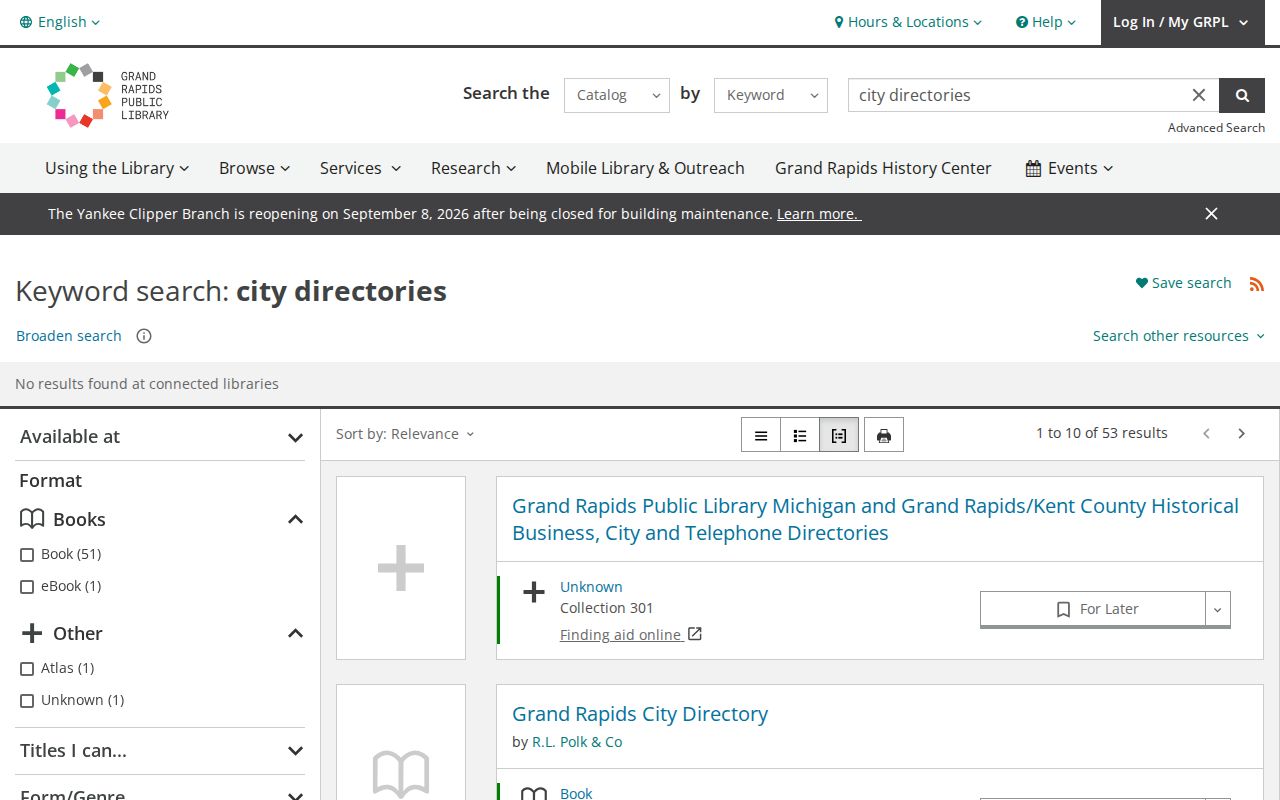
Catalog results establish what to request, not what an individual Walker entry will say. For broader manuscript, map, genealogy, cemetery, photograph, and oral-history material, the Historical Society of Kent County research inventory is another access channel. Its inventory work may make some material unavailable through at least 2027; staff questions are free for under 15 minutes, with longer research handled by direct inquiry.
The Grand Rapids Historical Society research page points researchers to the 1912 Polk address key, selected HathiTrust directory scans from 1859-1933, and local histories and directories by Dillenback & Leavitt, Baxter, Tuttle, and Chapman. Its contacts run through GRPL at 111 Library St NE, with 616-988-5497 and grhs.local@gmail.com listed for questions. This provides another informed-access route when a catalog entry, map, or local-history title needs interpretation rather than a simple name lookup.
GRPL also identifies specialized directories and telephone books. When an alphabetical volume does not provide the needed lead, ask whether a phone book, business directory, or collection file fits the date. Include the collection, box, and folder in an archive request. That level of detail respects the handling limits for fragile originals and helps staff locate the correct material during an in-person visit or a research inquiry.
Citation habit. Keep the directory year, title, publisher, section, page or scan, printed address, and access limitation together so another reader can retrace the same entry.