
Finding Walker Resident Records
No single public roll lists every household in Walker. So a residents directory search works best when it starts from the fact you already have. An address can lead to a parcel number and an owner field through the city assessor. It can also lead there through the county map. A recorded transfer belongs with the Kent County Register of Deeds. A name tied to a court matter fits the court index. An older household often shows up more clearly in a Grand Rapids Public Library directory volume. Each source answers a narrower question than a general people list.
Keep three ideas separate: ownership, mailing address, and occupancy. A tax parcel names an owner or taxpayer, not everyone living there. A city directory places a person at an address for the year the book came out. It says nothing more. Voter and court systems carry their own coverage gaps and privacy rules. Dated records, compared together, beat any single returned name.
- Start with the Walker assessor or Kent map when an address, owner name, or parcel number is known.
- Record the property address, parcel number, result date, and whether a field is an owner or mailing field.
- Use the deed index to locate a recorded transfer, then request or inspect the document if the legal chain matters.
- For a past household, compare Grand Rapids and Kent County directory volumes, reverse indexes, maps, and newspapers.
- Ask the named custodian for a specific record and date range when a public portal does not expose the needed item.
Walker Offices Behind Resident Records
A handful of custodians create the practical Walker residents directory trail. Walker Assessing keeps current ownership, value, and property characteristics. The Kent County Register of Deeds records deeds, mortgages, liens, and related instruments. The City Clerk runs local elections and routes city records requests. Michigan assigns voter and vital records to separate statewide custodians. Walker sits in Kent County. Grand Rapids holds the county seat, so county records are not all kept at City Hall.
Kent County Register of Deeds
300 Monroe Ave NW
Grand Rapids, MI 49503
616-632-7610
Deeds research and copies
Walker Assessing
4243 Remembrance Rd NW
Walker, MI 49534
616-791-6862
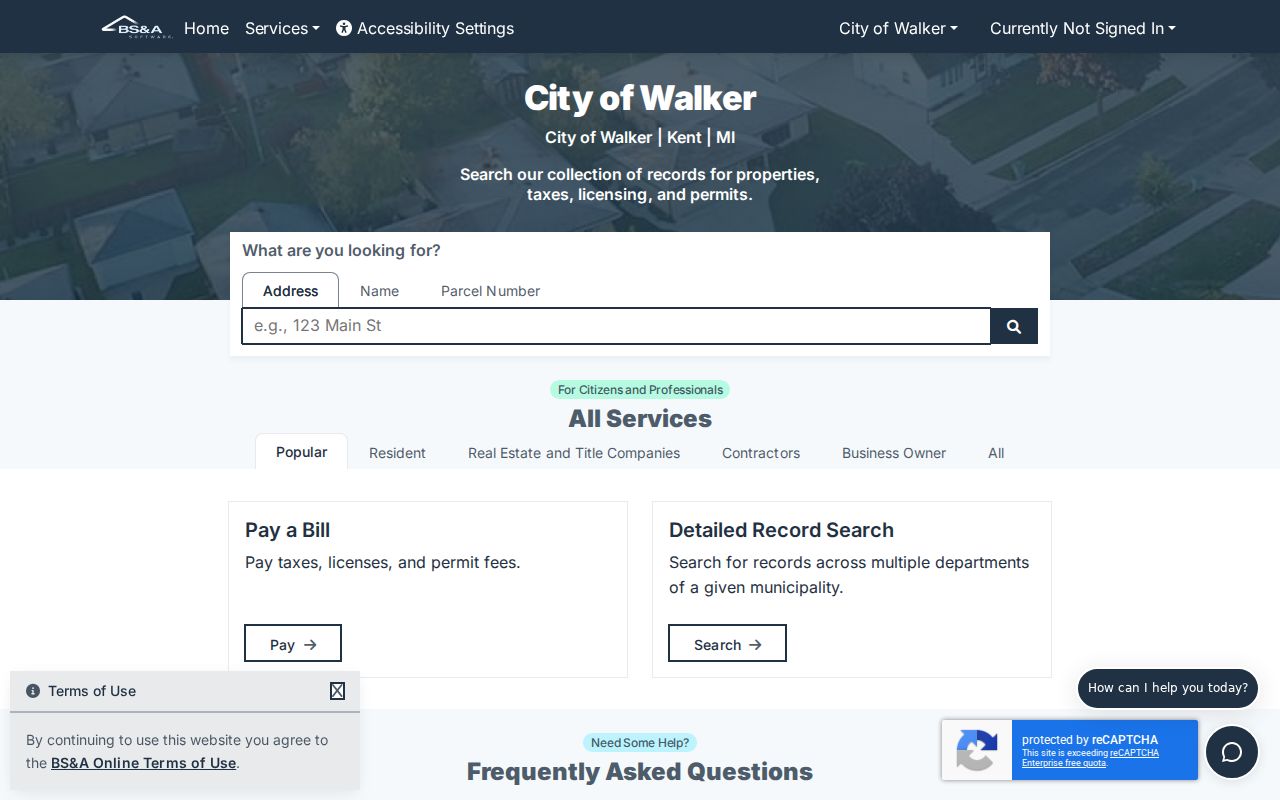
Walker BS&A Online
Walker Clerk and Michigan Elections
4243 Remembrance Rd NW
Walker, MI 49534
616-791-6865
Michigan Voter Information Center
Walker Parcel Records by Address
A Walker property search often starts from a street address. The city assessor is usually the strongest first stop. The Walker BS&A property portal serves as the local gateway for property and tax research. Its search routes cover records, taxes, sales, and building department files. Its documented controls include record category, address, owner name, parcel number, and an advanced-address option. Read each returned field exactly as the portal labels it. Kent's public parcel layer offers a second route. It separates the property or situs address from owner and taxpayer mailing fields. That distinction matters when tracing past residents.
A parcel number is called a PPN in Kent records. It is the steadiest way to carry a result between the assessor, the map, and the deed index. Address labels can shift over time. The parcel number does not.
The PPN is more than shorthand. Because it stays fixed while street names and owner names change, it prevents you from assuming two address labels describe the same parcel. Carry it into every records office you query.
| Field group | What it identifies | Careful reading |
|---|---|---|
| Property or situs address | The parcel’s physical location | Not necessarily an owner’s mailing line |
| Owner fields | Recorded tax-roll ownership data | Does not establish every occupant |
| Taxpayer fields | Tax correspondence contact | May differ from both owner and situs |
| PPN and class | Parcel identity and land classification | Use them to confirm the same property |
Walker Deed Index Research
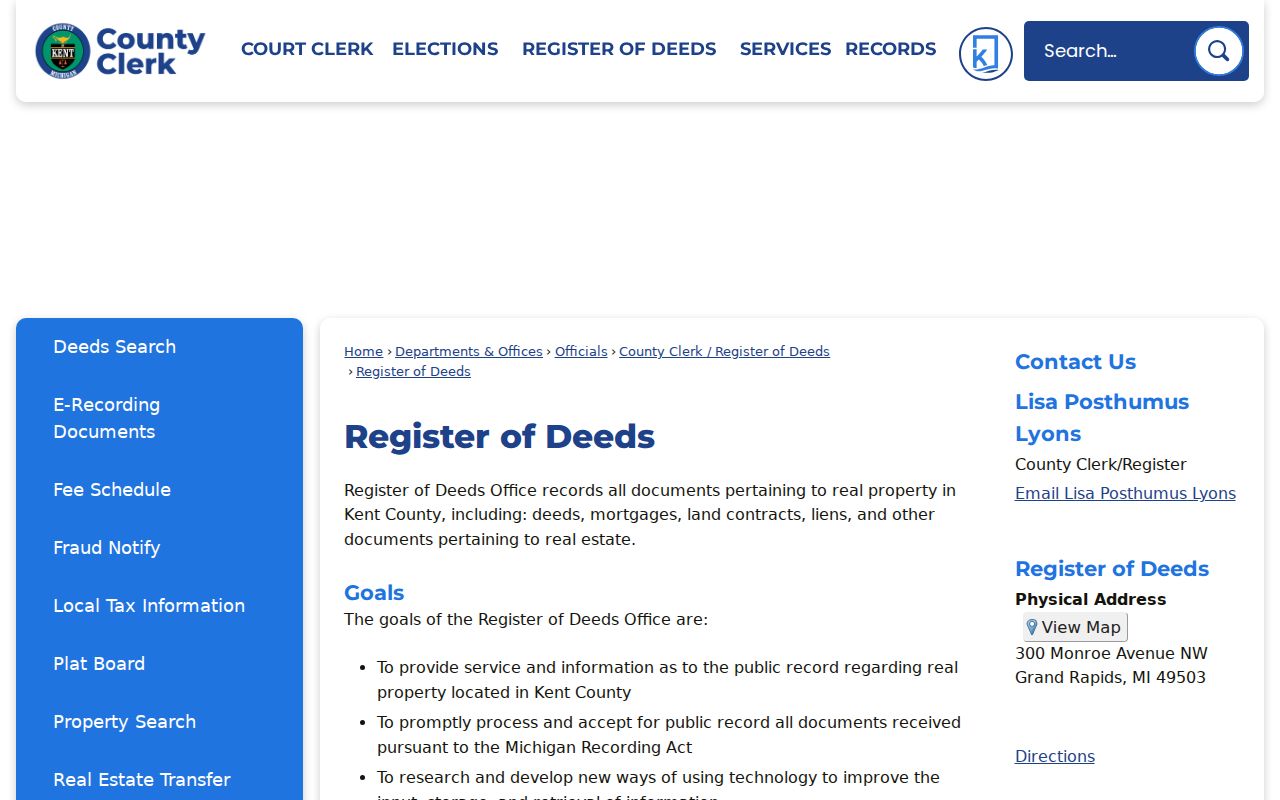
The Kent County deed index can connect a Walker parcel to its recorded transfers. But an index entry is not the legal document itself. Some researchers lack an owner name. The county tells them to begin with Equalization or the local assessor. Then search for that owner in the Register of Deeds system. The Deeds Self-Service notice compares its search to a library catalog, a guide rather than a guarantee. It also recommends trying spelling variants. The county publishes no online start year, image price, or complete field list.
The Kent Register of Deeds office provides research guidance. It also handles copy requests for the recorded instrument.
Test every hit before trusting it. Match the document number, recording date, grantor, grantee, and legal description against the parcel. A grantor transfers an interest; a grantee receives it. When a transfer date or a legal boundary matters, request the document itself.
- Parcel
- A mapped unit of land identified by a PPN or parcel number.
- Index
- A finding tool that points to a record, not necessarily the complete record.
- Grantor and grantee
- The transferor and recipient named in a recorded instrument.
- Criss-cross directory
- A reverse directory that can connect an address back to a printed name.
Note: The county publishes no online deed cutoff, so an empty web search should prompt an office or written-copy inquiry when the date range matters.
Current Walker Resident Sources
Current Walker residents directory evidence is scattered by design. Assessment and parcel records tie an owner or taxpayer to land. The Michigan Voter Information Center works as a self-service registration tool, while the more detailed Qualified File requires a controlled public-record request with protected fields stripped out. Recorded documents name parties to transactions. Court systems name parties to eligible cases. None of it forms a complete household roster, so check any name against date, address, or case details before reusing it.
| Walker source | What it may confirm | Custodian | Access route |
|---|---|---|---|
| Assessing and parcel layer | Owner, taxpayer, situs, parcel class | Walker and Kent County | Portal, GIS, office review |
| MVIC and QVF | Registration information within public-field rules | Michigan elections officials | Personal lookup or controlled request |
| Deeds Self-Service | Parties and recorded-transfer leads | Kent Register of Deeds | Index, document request |
| City staff directory | Public departments and roles | City of Walker | Online routing tool |
| Library directory collections | Dated name and address entries | GRPL and related collections | Catalog, onsite, microfilm |
Searching for one person rather than one parcel calls for comparing independent results, and the Walker resident lookup workflow walks through that process. A court name match is only a lead until it lines up with the right court, the right date, the right party role, and a second reliable record.
Walker Voter Record Boundaries
The Michigan Voter Information Center answers a personal question. Is my registration current, and where do I vote? You enter first and last name, birth month and year, and ZIP code. That workflow checks one person. It does not treat the voter file as a street-by-street list. Michigan does open registration records through a formal request process. The Qualified Voter File request form, though, shields sensitive fields. Driver-license and state-ID numbers stay private. So do month and day of birth, phone, email, signature, and the last four Social Security digits.
The request route allows defined geographic scopes and voter-history selections. Aim it at a real record question, not someone's entire life. An address may also be missing for a good reason. Michigan's Address Confidentiality Program provides substitute addresses that never surface in ordinary public results.
Note: Walker changed precincts in 2025. A historic precinct label and the current one may describe different boundaries.
Walker Court Name Checks
Court searches split by case type and by which court holds the record. Walker's local court is the 59th District Court, shared with Grandville. Its docket covers traffic, parking, small claims, and civil matters within its jurisdiction. It also handles criminal cases and marriage ceremonies. For a statewide starting point, Michigan's MiCOURT Case Search is public and free. It states plainly, though, that results are informational rather than the official record. Availability varies court by court, and nonpublic case types stay sealed.
A MiCOURT hit gives you a court, case number, party role, case type, and filing or status facts. Judge from those whether a request to the custodian makes sense. The 17th Circuit Court and Probate run separate Kent County routes. One statewide search will not answer every court question.
Michigan Vital Record Confirmation
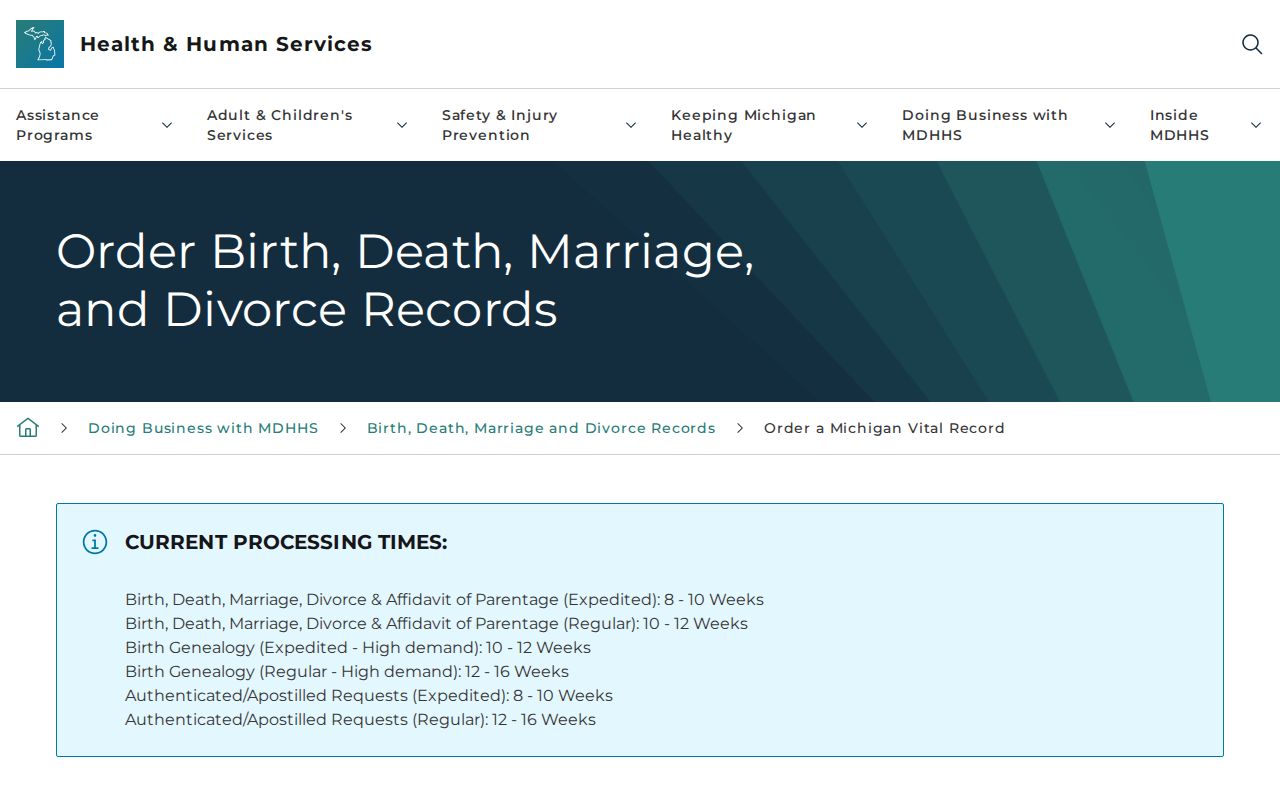
Certified copies of a Walker birth, death, marriage, or divorce record come from the Michigan MDHHS vital-record office. Statewide events reach back to 1867, and divorce records begin in 1897. Recent birth records stay closed under MCL 333.2882, though any birth record at least 100 years old is open by state rule. Death, marriage, and divorce files carry broader access, and a verification product shows fewer fields than a certified copy.
Orders can move by mail, an authorized online channel, phone, drop-box, or appointment and will-call. The standard search or copy fee is $34, a $14 online processing charge applies when applicable, and a no-record outcome does not refund the search fee. The MDHHS order page lays out the request path and the eligibility papers to send.
A verification confirms limited facts only: name, event date and place, and filing date. It is not the full certificate.
Walker Custody Record Scope
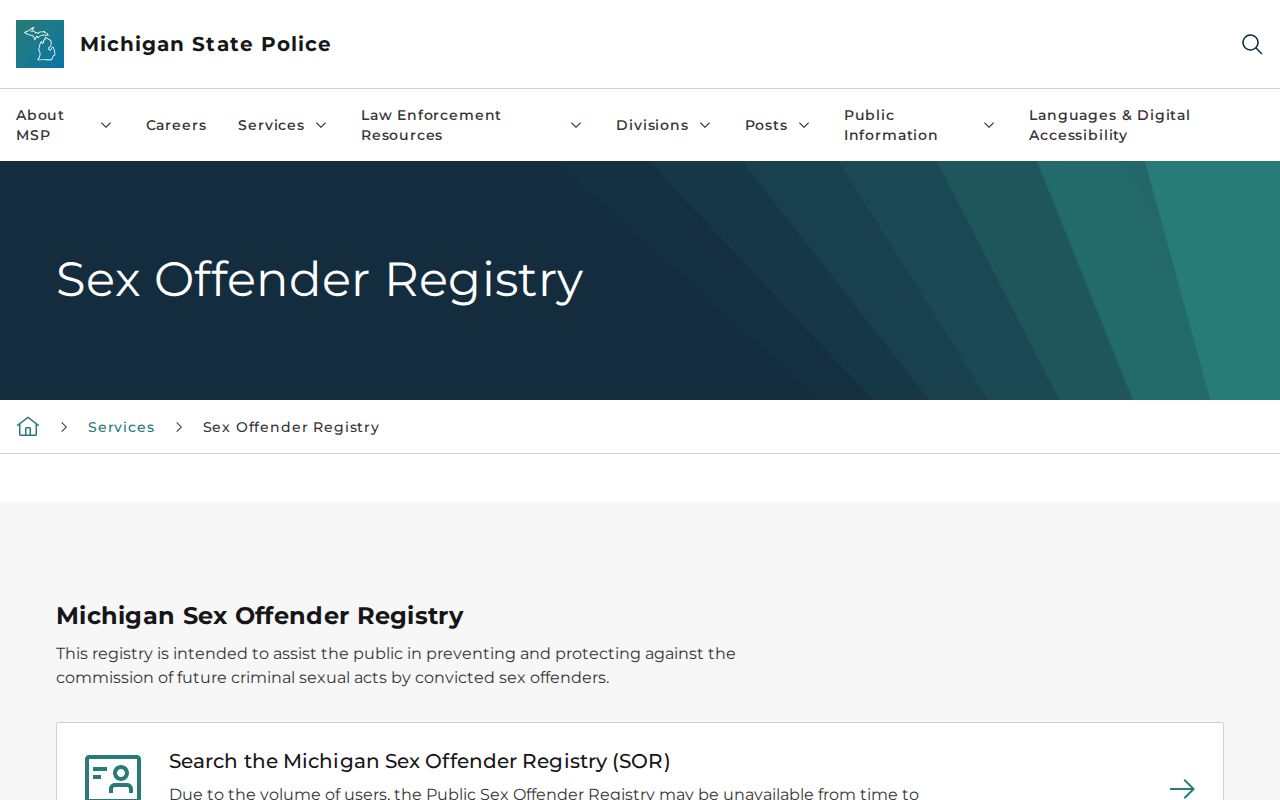
Each custody or registry system answers one narrow question. Kent County's jail viewer reflects current custody only. Michigan Department of Corrections OTIS covers the state prison system. The Michigan State Police registry has the scope its own law sets. ICHAT is a defined Michigan criminal-history product. A non-match proves nothing about a person's past. A match alone does not settle identity. Trust the official scope statement and the custodian's correction process above all.
The Michigan State Police registry page states its own search instructions and limits.
Keep these systems apart from a general residents directory inquiry. They cannot replace court records, and public case results can still omit protected or nonpublic matters.
Walker Business Record Context
A business or professional filing helps separate a commercial tie from a residential one. Michigan's LARA corporations service points users to MiBusiness Registry. It launched June 23, 2025. Its documented search modes cover entity name, individual name, identification number, and filing number. An entity record can surface a registered agent, a filing history, or a business status. It cannot support guesses about where someone lives at home. The LARA corporations gateway is the entry point for Michigan entity and filing services.
Local licenses run through Walker's Clerk. The city publishes no searchable license roster. A direct request or a FOIA filing is the documented fallback for a specific administrative record.
Walker Records When Portals Stop
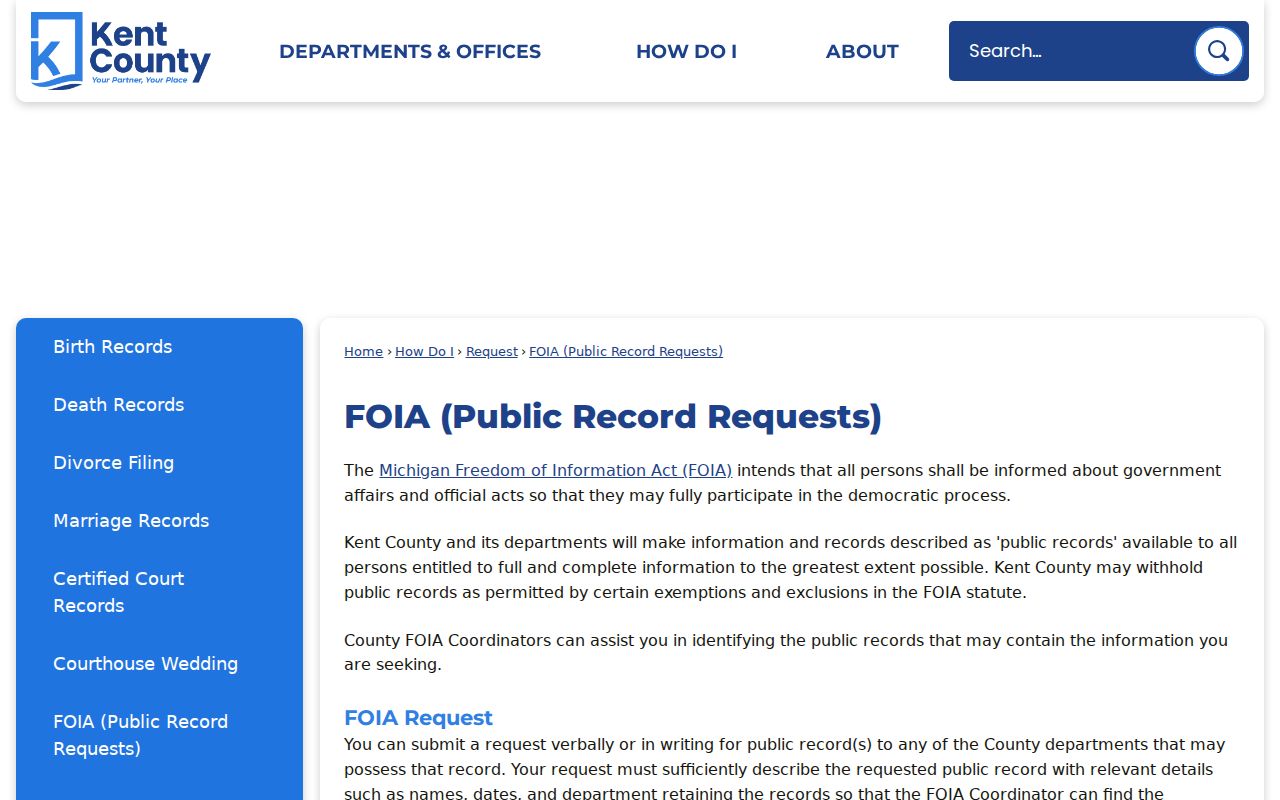
When an online index shows nothing, send the request to the custodian. That custodian created the record. Walker's City Clerk routes city public-record requests, with separate destinations for each department. Kent County accepts online, mail, fax, and hand-delivered requests. The Michigan Freedom of Information Act, 1976 PA 442, MCL 15.231 et seq., applies here. It generally requires a response within five business days. A ten-business-day extension is possible. Fees may include labor, copying, postage, and media under the applicable policy. The Kent County FOIA page lists current request methods, fees, and appeal steps.
A good request names a record type, an address or name if relevant, a date span, and the department. Asking for someone's whole personal file is less precise. It may also draw valid privacy redactions.
Walker Postal Geography Checks
The county's postal geography trips people up. Walker's official 2009 postal map lists four ZIP areas: 49321, 49504, 49534, and 49544. A piece of mail may carry a Grand Rapids postal line. But the parcel can still sit inside Walker. ZIP Code boundaries are not municipal limits, parcel lines, precincts, or planning neighborhoods. Before trusting any address classification, confirm the municipal location through Walker or Kent GIS. Then let USPS supply the current delivery ZIP. Resist the urge to treat 49534, the city-office mailing ZIP, as proof that every address in it belongs to one category.
Planning materials add another wrinkle. They lean on Alpine/Bristol, South Walker, Standale, and Northwest clusters. That boundary system never matches a residents directory roster. When a ZIP code directory entry seems to conflict with a planning label, compare the map's vintage against the record's own date first. The mismatch is often just two eras talking past each other.
Historical Walker Directory Trails
Tracing a Walker household through old city directory volumes usually leads into Grand Rapids collections. It also leads into Kent County holdings. The Grand Rapids Public Library describes its holdings as running from 1856 to the present. Its catalog coverage spans 1859 to 1998. Early microfilm covers 1856 to 1956. The Grand Rapids Suburban Directory runs from 1957 to 1997, with 1989 absent. Later years appear in Kent County East and West editions. Bresser's Cross-index Directory picks up the trail from 1962 to 2015. Each volume has its own geography. Check it before assuming a Walker address made the cut.
One printed entry can tie a name to an address for a given publication year. Phone or occupation sometimes appear in the bargain. The Walker city directories page walks through the full collection. It includes the alphabetical and reverse sections. GRPL's History Center sits on Level 4 of the Main Library. Some material there is onsite only. Research or copy services can carry a fee.
Note: Catalog gaps such as 1947, 1950, 1952, 1957, 1989, and 1991 reflect missing volumes, not missing households.
Walker’s Fire Gap in Records
Fire took Walker Township's original records in the mid-1800s. That loss reshapes any search for early families. A municipal register will not settle the question. Instead, set county deeds and plats beside church registers, newspaper notices, census schedules, neighboring-township material, and later histories. When the original record is gone, label the result as a reconstructed trail. Dates matter too. Walker Township began in 1837, the city incorporated in 1962, so note which governing body a record actually names.
Modern results deserve the same caution. Michigan's Address Confidentiality Program, voter rolls protections, restricted births, sealed court material, and redactions can all lawfully narrow what a resident lookup returns.